
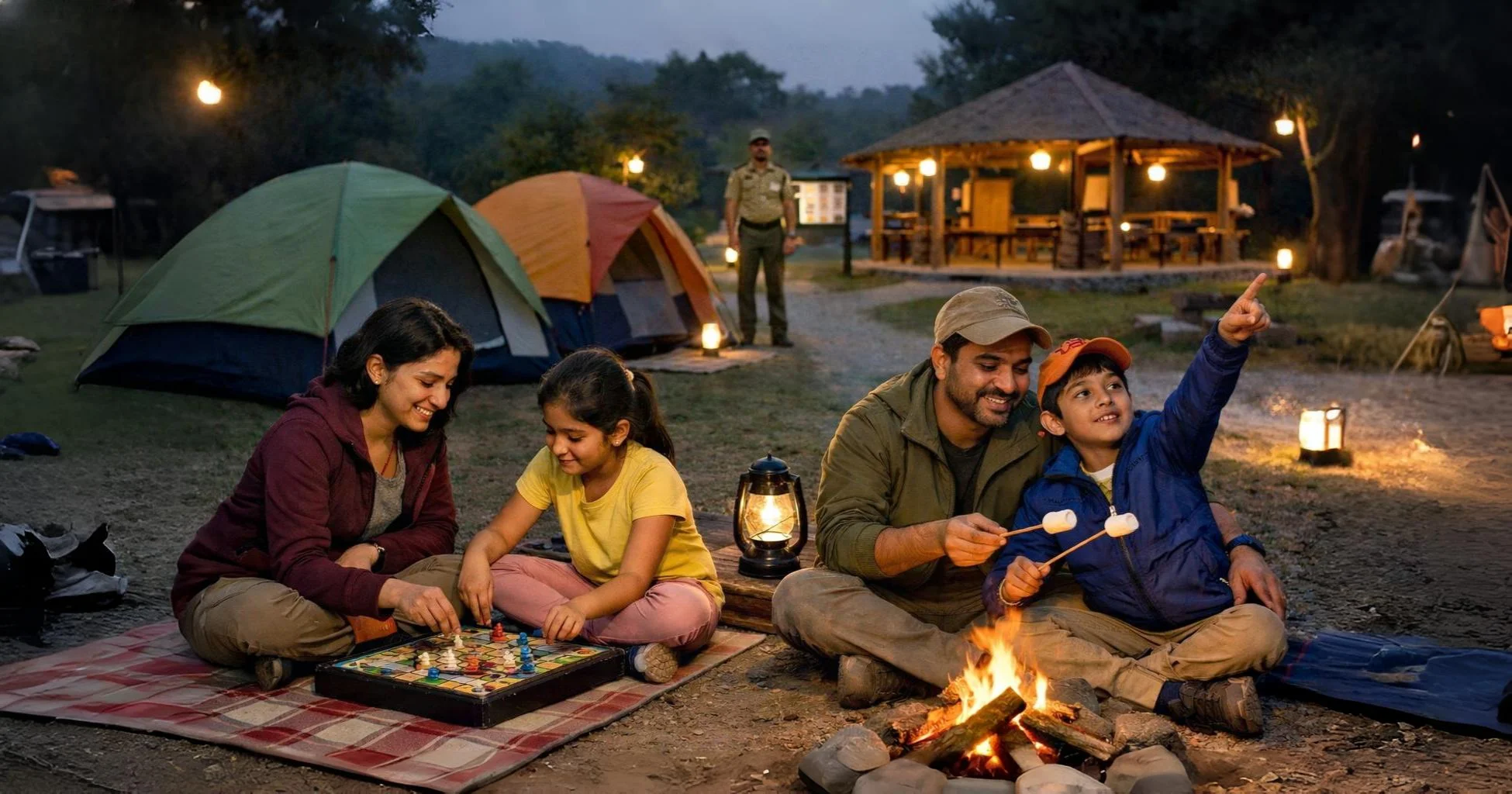
Is It Safe to Camp with Family in India? What Actually Determines Safety
A practical framework for families and couples to assess camping safety across locations, regions, and risk factors in India
When people think of family camping, images of organized national parks in the United States or well-equipped campgrounds in South Korea often come to mind. In comparison, camping in India is frequently perceived as risky—associated with wild animals, remoteness, unclear rules, and safety concerns.
Having experienced camping cultures abroad and observed India’s growing but uneven outdoor scene, one conclusion becomes clear: the real question is not “Is camping safe in India?” but “Under what conditions is it safe?”
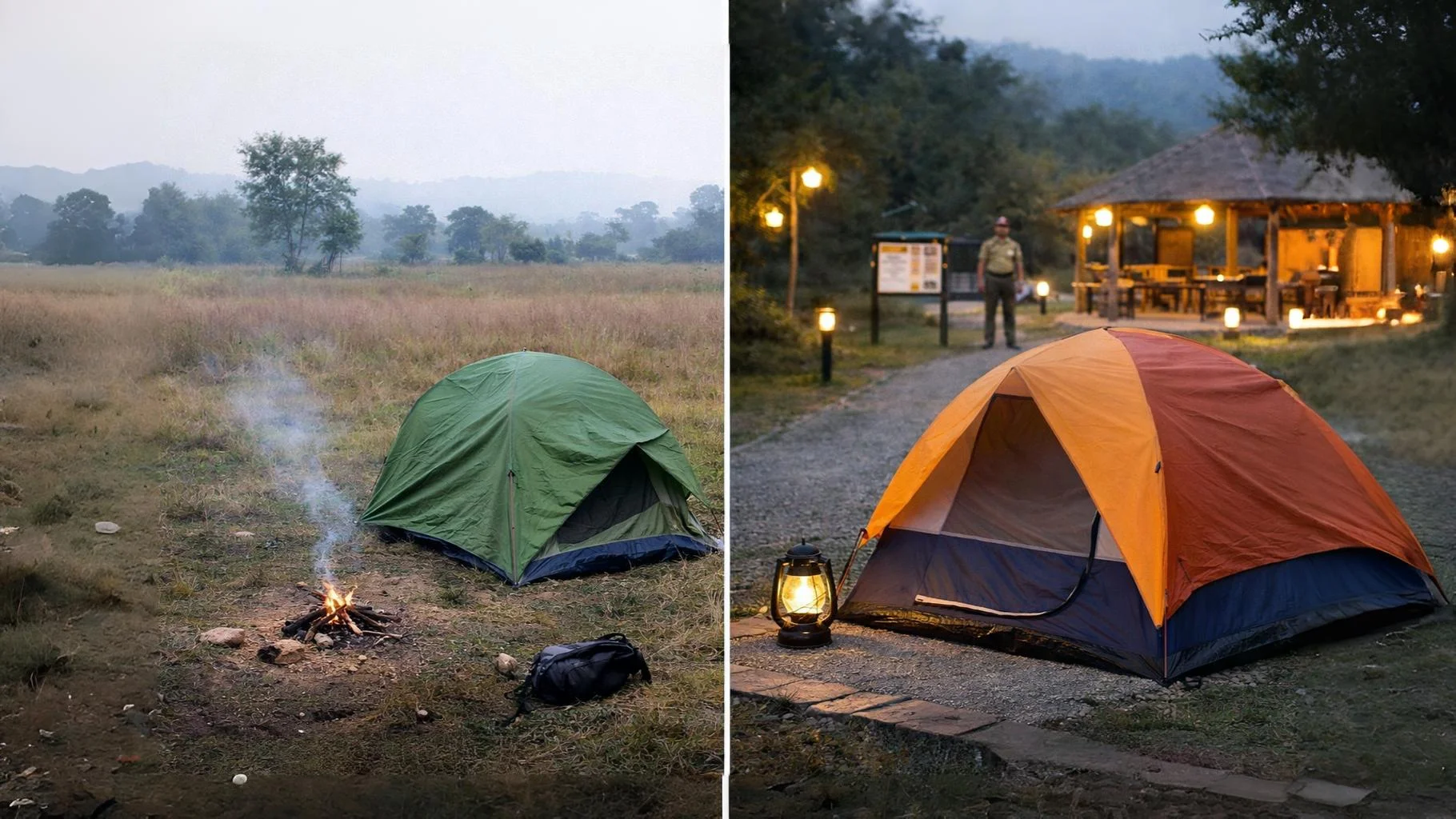
In India, camping safety is not a yes-or-no answer. It exists on a spectrum, shaped by location, geography, infrastructure, and human factors. Understanding where your trip falls on this spectrum is the key to making informed, confident decisions—especially when camping with children.
Table of Contents
⛺ Camping with family in India is generally safe in organized camps, situationally safe near villages and highways, and high-risk in wild or remote areas.
Safety depends less on the idea of “camping in India” and more on where you camp, regional hazards, access to help, and human preparedness.
Safety in India Is a Spectrum – Not a Yes/No Question
A night spent at a fenced, staff-managed campsite near Rishikesh is fundamentally different from pitching a tent in a remote Himalayan valley. Both are called “camping,” but their safety profiles are worlds apart.
Quick Decision Summary (For Families):
- Safest: Organized, commercial campsites
- Moderate risk: Camps near villages or highways
- High risk: Wild or remote camping areas
If you remember only one thing from this article, remember this: most family camping accidents in India are caused by choosing the wrong type of campsite—not by camping itself.
The Single Most Important Decision — Type of Campsite
Organized & Commercial Campsites (Safest for Families)
For families, especially first-time campers, organized campsites are by far the safest option. These are licensed operations designed specifically for recreational stays, where risk management is built into the experience.
Why they are safer:
- Physical security: Fencing or defined boundaries reduce wildlife encounters and prevent children from wandering.
- Professional oversight: Trained staff, safety briefings, and basic first-aid support are usually available.
- Reliable infrastructure: Clean toilets, potable water, lighting, and sometimes emergency power backup.
- Local knowledge: Operators understand weather patterns, seasonal risks, and regional hazards.
✅ Verdict: This option transfers much of the safety burden from the family to a professional system. It is the best starting point for family camping in India.
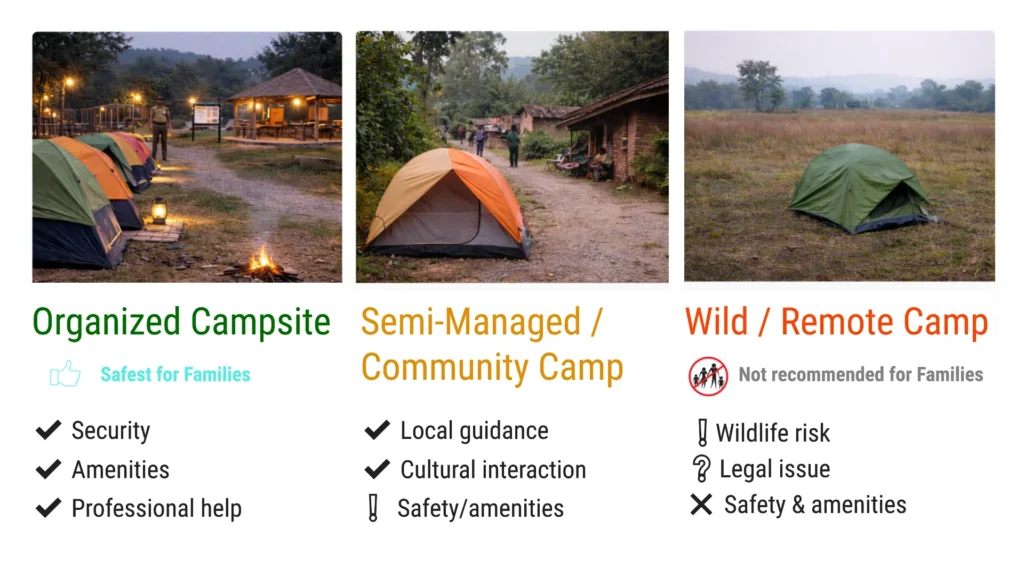
Community & Semi-Managed Camps (Moderate Risk)
These camps are often located near rural villages, farms, or highways. Safety here depends less on infrastructure and more on social context.
Advantages:
- Proximity to people means faster help during emergencies.
- Local residents often act as informal guardians once permission is established.
- Cultural interaction adds richness to the experience.
Limitations:
- Land-use permissions can be ambiguous.
- Sanitation and waste management may be inconsistent.
- Safety standards vary widely.
💡Key insight: A respectful introduction, clear communication, and local permission can significantly improve safety—but families must remain vigilant and self-reliant.
Wild & Remote Camping (Why Families Should Avoid It)
Wild camping is often romanticized online, but in India it carries serious legal, environmental, and safety risks, especially for families.
Critical realities:
- Camping is strictly prohibited in National Parks, Tiger Reserves, and Wildlife Sanctuaries.
- Risk of wildlife encounters, including elephants, leopards, and bears.
- Possibility of being mistaken for illegal entrants or poachers.
- Complete self-responsibility for medical, evacuation, and communication needs.
✅ Verdict: Wild camping is suitable only for highly experienced adults with professional support. It is not recommended for family trips.
Campsite Safety Comparison (Quick Reference)
| Campsite Type | Safety Level | Suitable for Families |
|---|---|---|
| Organized commercial camps | High | ✅ Yes |
| Village / semi-managed camps | Medium | ⚠️ With caution |
| Wild / remote camping | Low | ❌ No |
How Geography Changes Camping Safety in India
Camping safety is not just about where you camp, but what the land itself does to risk. Geography dictates everything a family cannot control: how fast weather changes, how animals move, how water behaves, and how difficult rescue becomes. The same tent, gear, and preparation that feels perfectly safe in one region can become inadequate—or even dangerous—in another. For families, understanding geography is less about adventure and more about anticipating how quickly conditions can turn against comfort, health, and decision-making. It can be really critical for first-time campers.
India amplifies this reality. Few countries compress such extreme geographic contrasts into short distances: snowbound mountains, rainforest belts, arid deserts, flood-prone river plains, and cyclone-exposed coastlines. Unlike countries with standardized national park systems and uniform signage, Indian camping environments vary wildly in regulation, infrastructure, and emergency access. This means safety rules cannot be universal. A strategy that works in the Western Ghats may fail entirely in the Himalayas. Families who treat Indian geography as interchangeable terrain often misjudge risk—not because they are careless, but because the landscape itself demands region-specific thinking.
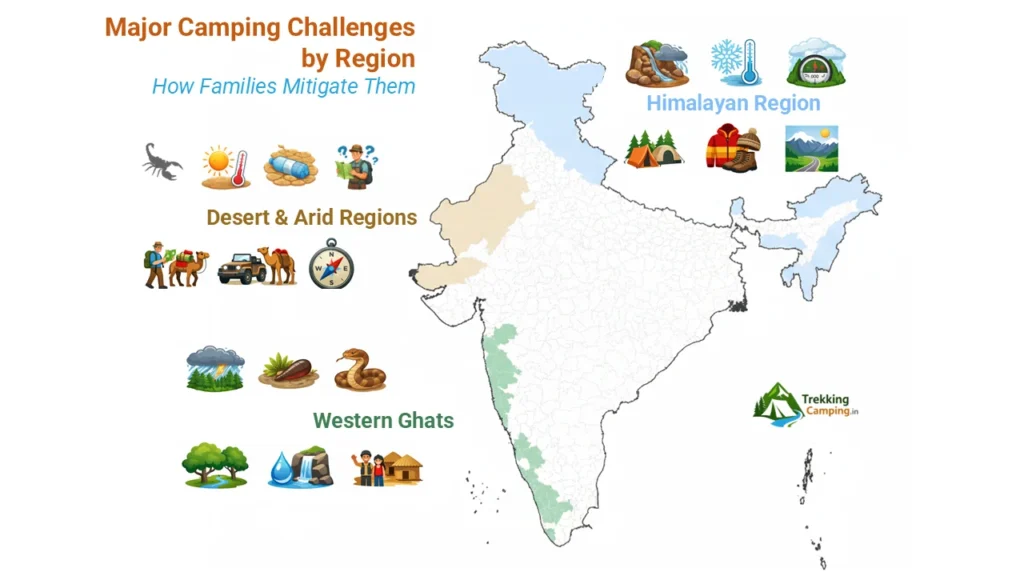
Himalayan Region (Himachal, Uttarakhand, Sikkim)
Primary risks:
- Landslides, flash floods, seismic activity
- Rapid temperature drops
- Altitude sickness, especially in children
Family mitigation:
- Choose established campsites only
- Camp at least 200 feet from riverbeds
- Allow gradual acclimatization
- Pack for cold nights—even in summer
Western Ghats (Maharashtra, Karnataka, Kerala)
Primary risks:
- Heavy monsoon rains
- Leeches, snakes, high humidity
- Slippery terrain
Family mitigation:
- Avoid peak monsoon season
- Use moisture-wicking clothing
- Store food securely to deter wildlife
- Perform frequent body checks for leeches
Desert & Arid Regions (Rajasthan, Kutch)
Primary risks:
- Extreme heat
- Rapid night-time temperature drops
- Venomous snakes
- Navigation challenges
Family mitigation:
- Camp only with reputable operators
- Carry significantly more water than estimated
- Prepare for large temperature swings
- Avoid independent camping
Human Safety Factors Families Often Ignore
This is where most safety failures actually occur.
Child Safety in Open Camps (Where Most Safety Failures Actually Occur)
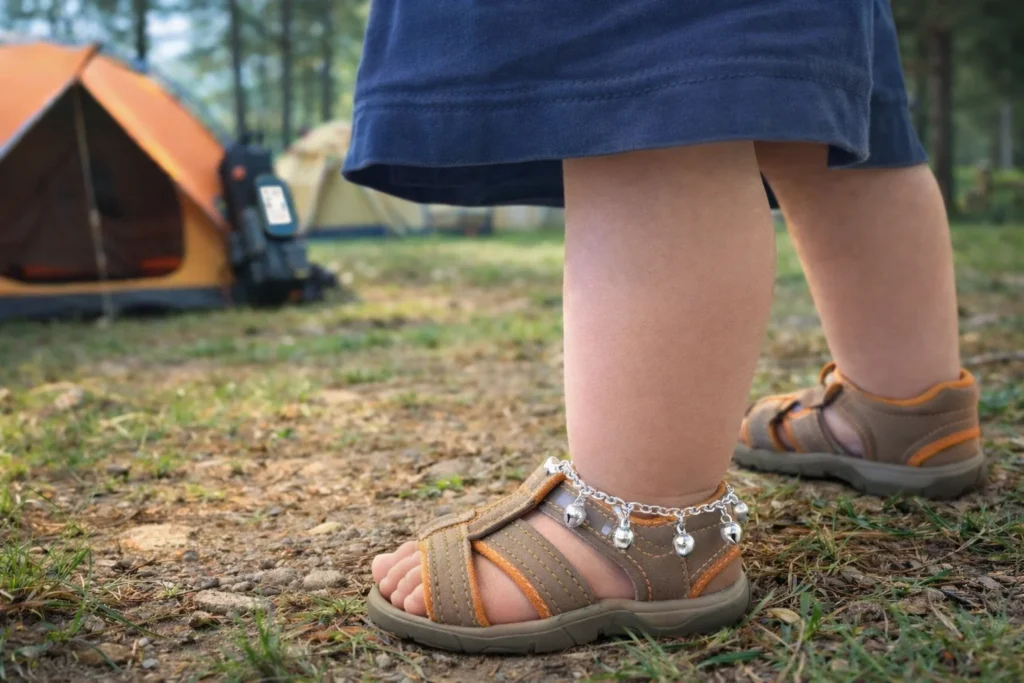
Children don’t perceive risk the way adults do — and that gap widens in open outdoor environments. In Indian camping contexts, most safety incidents involving children aren’t dramatic wildlife encounters; they’re simple loss-of-visual-contact moments that escalate due to terrain, crowds, or low visibility.
Effective child safety in camps is less about high-tech gear and more about layered awareness systems.
1. Define Boundaries Using Physical Landmarks
Instead of abstract rules (“don’t go far”), use clear, visible anchors:
- a specific tent
- a large tree
- a parked vehicle
- a campsite signboard
Children understand place-based limits far better than distance-based instructions.
2. Audible Tracking Still Works — and It’s Gender-Neutral
Traditional audible tracking methods—such as a child payel / tora / nupur (anklet) with small bells, often called jhunjhunu or ghungru—are frequently misunderstood as decorative or gender-specific. In reality, they have long been used across Indian households for practical child-tracking, regardless of gender.
On open campsites, these anklets provide continuous, low-effort auditory awareness, especially in crowded areas, on uneven terrain, or inlow-light conditions. Their value lies not in tradition, but in instant location feedback without screens, batteries, or network dependence. In reality, they are:
- practical
- culturally familiar
- effective in crowded or low-visibility environments
Many families (including for boys) use bells at home or during gatherings to maintain auditory awareness. In camps, this becomes even more valuable — especially around dusk, early morning, or busy common areas.
3. Blend Tradition with Modern Tools
For older children, combine low-tech cues with modern backups:
- a whistle for emergency signaling
- walkie-talkies in no-network zones
- GPS trackers where terrain allows
The goal isn’t constant monitoring — it’s fast reorientation if separation happens.
4. Supervision Timing Matters More Than Constant Supervision
The highest-risk windows are:
- dawn and dusk
- meal preparation times
- moments of adult distraction (packing, setting tents, conversations)
Planning supervision shifts during these periods is more effective than attempting round-the-clock vigilance.
Bottom line:
Child safety in Indian camps works best when families accept a simple truth — you are the primary safety system. Campsites, staff, and infrastructure support you, but awareness, boundaries, and culturally adapted practices are what actually prevent incidents.
Sanitation & Gender Safety
For families, especially those with women and girls, sanitation is not a comfort issue—it is a safety issue.
- Organized camps with private toilets significantly reduce risk
- Poor sanitation is a leading reason families abandon camping in India
- Modest clothing and respectful behavior reduce unwanted attention in conservative areas
Social Norms & Local Communities
Engaging respectfully with local communities enhances safety:
- Inform locals of your presence
- Seek permission when unsure
- Follow local customs regarding noise, dress, and behavior
Camping respectfully often converts strangers into allies.
Emergency Reality — Why Distance Matters More Than Isolation
In India, rescue response time depends far more on accessibility than on how remote a place feels.
- Mobile networks are unreliable in many regions
- Even professional rescue forces (SDRF/NDRF) take time to reach difficult terrain
- The most practical strategy is the “highway sweet spot”: camping within 1–2 km of an all-weather road
Preparedness checklist:
- Save emergency numbers (112, 100)
- Assume no mobile network
- Carry physical maps and basic first-aid
- Plan self-evacuation routes in advance
So, Is It Safe to Camp with Family in India?
The short, honest answer: yes—but only if you choose correctly.
✅ Safe if:
- You use organized or well-managed campsites
- You account for regional hazards
- You plan for sanitation, communication, and emergencies
⚠️ Risky if:
- You camp on ambiguous land without permission
- You underestimate weather, terrain, or distance to help
❌ Avoid if:
- You plan wild or remote camping with children
- You rely solely on mobile phones for safety
- You ignore local laws or wildlife regulations
Final Thought
Family camping in India is not unsafe, it is context-dependent. When approached with informed planning, respect for geography and communities, and realistic expectations, it can be deeply rewarding.
Safety is not luck.
It is the result of deliberate choices.
FAQs: Family Camping in India
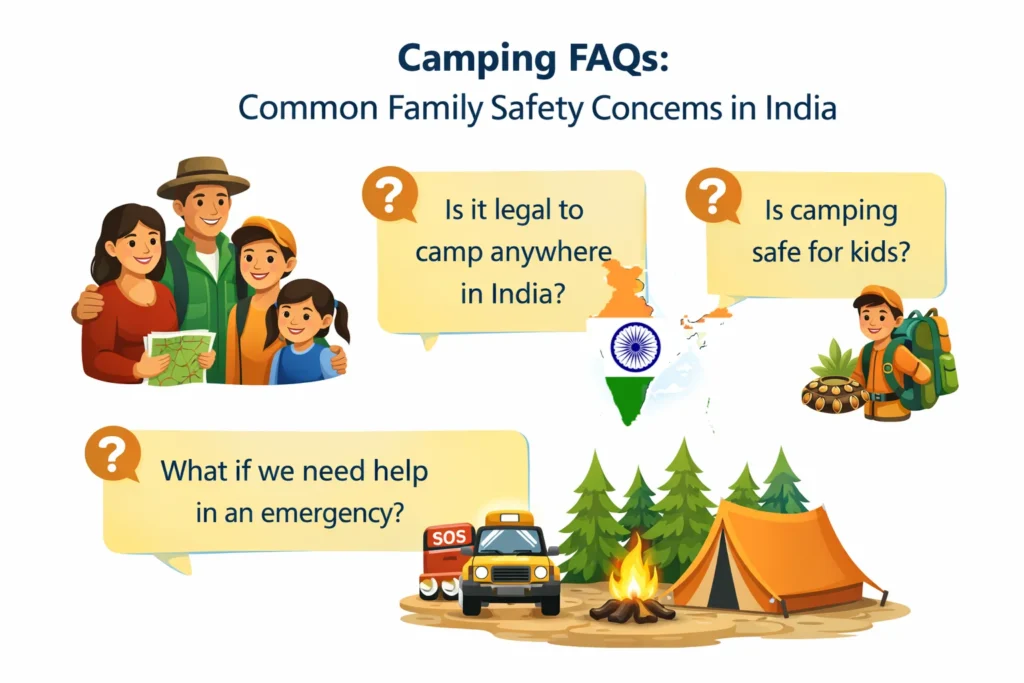
Family camping in India often brings equal parts excitement and uncertainty. These frequently asked questions break down what actually determines safety—so you can make confident, informed decisions instead of relying on assumptions or fear.
Is it safe to camp with family in India?
Short answer: Yes—when the conditions are right.
Camping safety in India is not a simple yes-or-no question. It depends primarily on where and how you camp. Staying at an organized, licensed campsite with staff, security, and basic infrastructure offers a high level of safety comparable to a family resort.
Risk increases sharply with semi-managed or wild camping, which demands advanced preparation and local knowledge. For families or first-time campers, choosing a well-managed campsite is the single most important safety decision.
Where are the most family-friendly camping places in India?
The safest camping places for families in India are organized campsites in accessible natural regions, not isolated wilderness areas.
Good starter regions include:
Rishikesh & Coorg – Known for licensed camps with staff, medical protocols, and family-friendly activities
Himalayan foothills (around Shimla, Manali, Mukteshwar) – Scenic without extreme altitude or remoteness
Eco-camps near wildlife reserves (outside core zones) – Places near Kanha or Nagarhole that offer guided experiences without wild camping risks
What matters more than the destination name is the type of campsite and its management.
What should I check before choosing a campsite?
Use this practical checklist:
1) Infrastructure: Fencing or defined boundaries, clean toilets, safe drinking water, lighting
2) Staff & Oversight: On-site manager, night staff, basic first-aid readiness
Location Logic: Within 1–2 km of an all-weather road; not on dry riverbeds or flood zones
3) Credentials: Licensed operator, clear safety briefings, transparent rules
4) Emergency Plan: Clear protocol for medical help and evacuation
If a campsite cannot clearly answer these questions, treat that as a warning sign.
Are camping safety rules different in India compared to other countries?
Yes—very much so.
Key India-specific considerations:
1) Wild camping is restricted or illegal in National Parks, Wildlife Sanctuaries, and Tiger Reserves
2) Climate risks are extreme: sudden temperature drops in mountains, intense monsoon rain, or desert heat
3) Water safety matters more: drink only purified or sealed water
4) Social context matters: engaging politely with locals often improves safety and cooperation
Applying Western camping assumptions directly to India can lead to poor decisions.
What are the biggest risks when camping with kids in India?
The main risks are children wandering off, minor injuries, and poor hygiene.
How to manage them:
A. Prevent getting lost:
1) Identify a clear “home base” landmark
2) Use bells, whistles, or walkie-talkies
3) GPS trackers help but should not be your only solution
B. Wildlife awareness:
1) Organized camps manage this risk
2) Teach kids never to approach animals or leave food unattended
C. Health & hygiene:
1) Carry ORS, antiseptics, insect repellent, and personal medication
2) Enforce handwashing before meals
Supervision matters most during early morning and evening hours.
What is the best advice for first-time family camping in India?
Start simple and controlled.
1) Choose a highly rated, organized campsite
2) Limit the trip to 1–2 nights
3) Avoid peak summer and monsoon seasons
4) Treat the first trip as a learning experience—not an adventure test
Confidence grows faster when early experiences are positive.
What essential gear is often overlooked in India?
Commonly missed but critical items include:
1) Sleeping pads (for insulation, not just comfort)
2) Headlamp for each person
3) High-capacity power bank
4) Closed-toe footwear for everyone
5) Physical map or offline navigation
Do not rely entirely on mobile networks or GPS.
Who should I contact in an emergency?
Save these numbers offline:
112 – All-in-one emergency number (India-wide)
108 – Medical emergency (state-dependent)
100 – Police
NDRF-011-26107953, 09711077372
Campsite manager or guide – Often the fastest and most effective first response
In remote areas, self-evacuation time matters more than signal availability.
Editorial Note:
Outdoor safety in India is not about fear—it’s about informed choices.
Last updated: January 24, 2026
We review and update our guides periodically based on new field insights, safety advisories, and reader feedback.