
Do You Need a Guide in the Himalayas? A Practical Decision Framework for Independent Trekkers
The Question Every Himalayan Trekker Faces
It often begins as something small-a headache you blame on dehydration, a trail junction missing from your downloaded map, clouds building faster than the forecast suggested. You’re at 4,200 meters, a day from the nearest road, and the question you postponed during planning suddenly feels urgent: should I have hired a guide? This article exists so you can ask that question-“Do you need a guide in the Himalayas?”-before the mountain forces it on you.
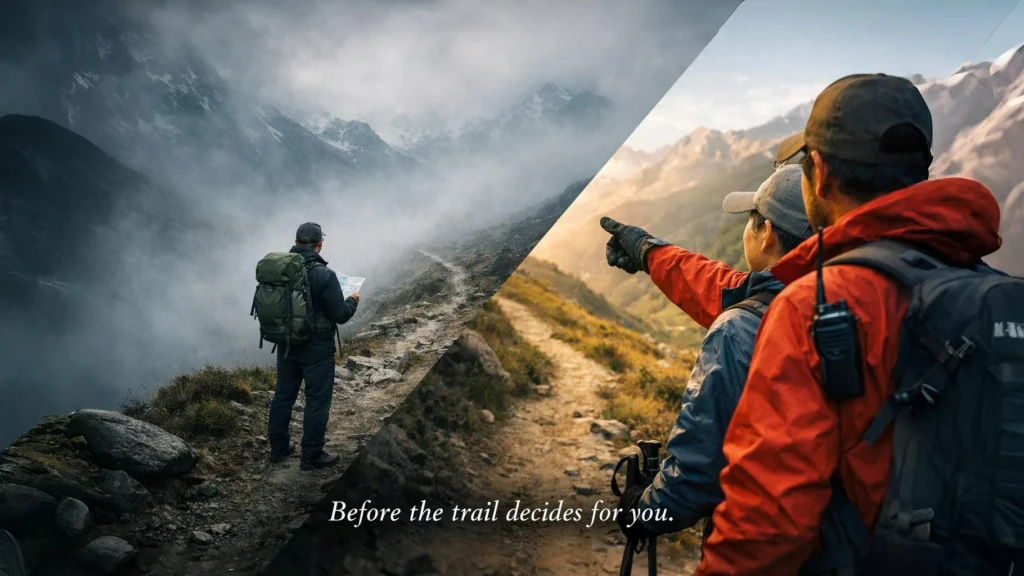
In the Himalayas, the choice between independent trekking and guided trekking is usually framed as freedom versus safety, solitude versus structure. This is a false dichotomy. The real distinction is between understanding your limits in advance and having those limits revealed by altitude, weather, or terrain when options are already narrowing.
The mountains don’t respond to confidence, past achievements, or careful budgeting. They operate on weather systems, oxygen availability, and terrain stability. This article isn’t here to sell guided tours or glorify independence. Its purpose is narrower-and more useful: to help you judge, before you start walking, whether your skills, preparation, and risk tolerance realistically match the demands of a Himalayan trek.
The goal is not certainty. It’s informed judgment.
Table of Contents
Quick Answer: Do You Need a Guide in the Himalayas?
If you want a decision snapshot before reading further, start here.
A guide is usually necessary or strongly advised if your trek involves:
- High altitude: Routes ascending above ~4,500 meters, where Acute Mountain Sickness can escalate rapidly and requires experienced monitoring and conservative decision-making.
- Restricted or protected areas: Parts of Sikkim, Ladakh, Uttarakhand, and border regions where permits often legally require a registered guide.
- Complex terrain: Glacier travel, high mountain passes, or major river crossings where technical judgment and local route knowledge reduce objective risk.
- Extended isolation: Routes longer than 7–10 days with few villages, where resupply, self-rescue, and emergency evacuation become significantly harder.
Independent trekking may be a reasonable choice if your route features:
- Established teahouse or village networks: Well-travelled routes such as Markha Valley or Sandakphu, where regular human presence provides logistical and safety buffers.
- Moderate altitude: Routes staying largely below ~3,500 meters, where altitude-related medical risk is substantially lower.
- Clear navigation: Marked, non-glacial trails during stable seasons, where route-finding errors are unlikely.
🏞️ The core principle: safety in the Himalayas depends less on confidence and more on accurately diagnosing the gap between your preparedness and the mountain’s demands. The sections that follow are designed to help you make that diagnosis clearly-and early.
The Real Risks of Trekking Without a Guide
This is not a list of dangers meant to scare you into hiring a guide. It is a clear-eyed look at how Himalayan conditions behave-and how the absence of a trained, local presence amplifies their consequences for independent trekkers. The risk is rarely that something will go wrong; it’s that when it does, you are simultaneously the patient, navigator, and decision-maker.
The Trail Moment
You ignore a headache for hours, blaming dehydration. At 4,700 meters, nearing high camp, nausea sets in and your coordination feels off. You’re alone-or with friends who are equally exhausted. Do you push one more hour to shelter, or descend immediately and give up progress? This is where a guide stops being a convenience and becomes a safeguard: an objective third party trained to recognize when discomfort has crossed into danger.
Why This Happens: The Himalayan Risk Triad
1. Altitude Is Unpredictable
Fitness at sea level offers little protection at altitude. Acclimatization varies between individuals and even day to day. Without experienced observation-gait, behavior, breathing patterns-early warning signs of altitude illness are easy to rationalize away until they escalate.
2. Weather Changes Faster Than Forecasts
Himalayan weather is shaped by microclimates. Clear skies at camp can hide a storm building beyond a ridge. What appears to be a light valley shower can turn into a whiteout at a high pass. Guides rely not just on forecasts, but on terrain-specific cues-cloud movement, wind shifts, seasonal patterns-that independent trekkers rarely recognize in time.
3. Technology Creates False Confidence
GPS devices and offline maps fail more often than people expect. Cold drains batteries. Deep valleys distort satellite signals, introducing dangerous location errors. More critically, satellite messengers and personal locator beacons are illegal in India without special licenses. When your phone loses signal, it is not a backup-it is silence.
Consequences: The Decision Cascade
In the Himalayas, accidents rarely happen all at once. They unfold:
- Delayed descent: Mild AMS becomes severe because retreat feels premature.
- Impaired judgment: Fatigue and hypoxia lead to shortcuts, misread terrain, or risky crossings.
- Rescue dependency: A manageable injury becomes life-threatening when self-evacuation fails, triggering complex and costly rescue operations.
A guide’s value lies in interrupting this cascade early-before bad decisions stack.
⚠️ Key Takeaway: Risk in the Himalayas is not a personal weakness; it is an environmental constant. Guides reduce risk not by eliminating danger, but by monitoring, interpreting, and intervening before consequences compound.
What Altitude Actually Does to Your Body
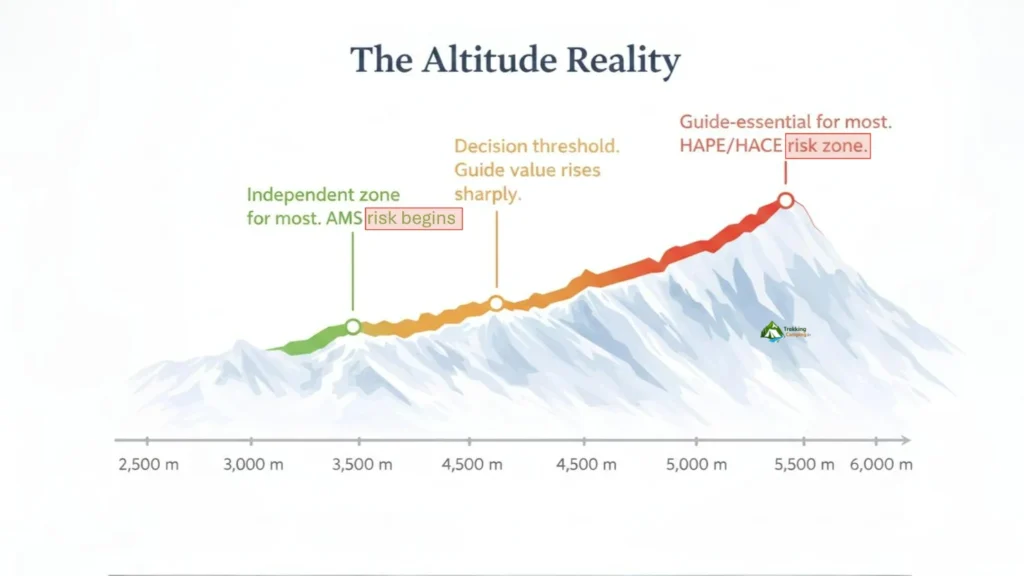
For independent trekking, the challenge is not understanding altitude illness in theory-it is recognizing it in yourself early enough to act. Many first-time trekkers dismiss early symptoms as fatigue or dehydration, even though AMS can escalate to life-threatening HAPE or HACE within hours, especially above 4,500 meters, a pattern we break down in detail in our analysis of common first-time trekking mistakes.
| Condition | Early Symptoms | Independent Trekker’s Blind Spot |
| Mild AMS | Headache, nausea, poor sleep | Easily dismissed as dehydration or fatigue |
| HAPE | Breathlessness at rest, cough, weakness | “Just tired” until movement becomes impossible |
| HACE | Loss of coordination, confusion | Victim often unaware of impairment |
Why guides matter here: they provide redundant monitoring-observing gait, breathing, and mental clarity, before symptoms feel severe to the person experiencing them.
Weather & Terrain Reality in the Himalayas
- Rapid whiteouts: On high routes, visibility can collapse within minutes, erasing trails entirely. In such conditions, precise bearings and shelter knowledge matter more than fitness.
- River crossings: Morning streams can become dangerous by afternoon due to snowmelt and rain. Timing is not optional, it is learned.
- Seasonal deception: A “safe” trail in autumn can be snow-covered or icy in spring. This is not bad luck; it is predictable terrain behavior.
Navigation Isn’t Just GPS
Navigation plans must assume failure.
- Power fails: Cold drains batteries; solar chargers depend on sun.
- Signals fail: Valleys distort GPS accuracy; maps omit cliff bands and unstable slopes.
- Communication fails: Legal SOS options vanish minutes beyond road access. Guides rely on permitted radio networks tied to villages and local responders.
When a Guide Is Mandatory (Not a Preference)
A common misconception among independent trekkers is that hiring a guide is always a matter of budget or comfort. In many parts of the Indian Himalayas, it isn’t. It is a legal and administrative requirement. In these regions, you are not choosing between guided and unguided trekking, you are choosing between compliance and being turned back.
The Trail Moment
You’ve reached the trailhead after days of travel. At the forest barrier or an ITBP checkpoint, your permits are checked. The officer asks a simple question: “Where is your guide?” You don’t have one. The exchange is brief and polite. There is no appeal, no workaround. Your trek ends here.
Why These Rules Exist
Mandatory guide regulations are not arbitrary. They exist for three practical reasons:
- Border security: Large parts of the Himalayas lie in sensitive frontier zones bordering China and Pakistan. Regulated movement and local accompaniment are standard security protocols.
- Environmental protection: Fragile alpine ecosystems cannot absorb unregulated foot traffic. Guides act as accountable stewards for waste management and trail discipline.
- Rescue risk management: High-altitude rescues often involve state disaster forces and military assets. Requiring guides reduces preventable emergencies and improves coordination when rescues do occur.
Consequences of Ignoring the Rule
At best, you lose your trek after significant time and expense. At worst, you face fines or legal complications for attempting to enter restricted zones without authorization. More importantly, if trouble arises after bypassing a checkpoint, rescue becomes slower and more complicated, you are now an unregistered entrant in a crisis.
⚠️Key Takeaway: Before evaluating trail difficulty or fitness requirements, verify the legal status of your route. Some Himalayan treks are guided-only by law, regardless of experience or confidence.
Permit & Regulation Reality (India-Specific)
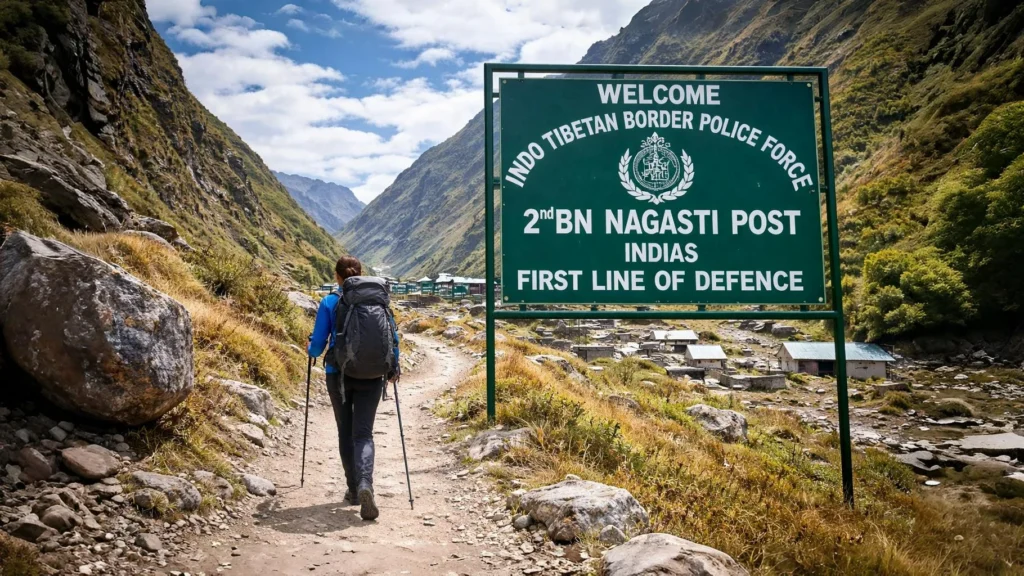
Regulations change frequently. What follows reflects the current enforcement pattern, not a guarantee. Always verify with state tourism portals or registered local operators before departure.
| Region | Permit Required | Guide Status | Practical Reality |
| Sikkim (North & East districts) | PAP / RAP | Effectively mandatory | Permits issued only via registered operators; solo trekking is rarely permitted |
| Uttarakhand (core sanctuaries) | Forest / Park permits | Mandatory in core zones | Enforcement increasing; guides often checked at checkpoints |
| Himachal Pradesh (border belts) | ILP (route-specific) | Often required | High-risk routes increasingly require documented guide support |
| Ladakh (remote valleys & winter treks) | PAP | Frequently mandatory | Ecological compliance strictly enforced; guides expected |
Verification rule: if enforcement is unclear, assume a guide is required. Gateway towns (Gangtok, Leh, Manali, Joshimath) provide the most reliable, current interpretation.
Terrain Where Skill Alone Isn’t Enough
Even where guides are not legally required, certain terrain shifts the equation from trekking to risk management.
- Glaciers and moraines: Crevasses, unstable debris, and hidden ice make untrained navigation extremely dangerous.
- High passes (>5,000 m): Weather windows are narrow, exposure is high, and retreat options are limited.
- Extended isolation (10+ days, no villages): Logistics, rationing, campsite safety, and emergency planning become as critical as physical fitness.
Bottom line: if your route appears in the table above or involves these terrains, the decision has already been made. The question is no longer whether to hire a guide, but which qualified guide to trust.
When Independent Trekking Is Usually Reasonable
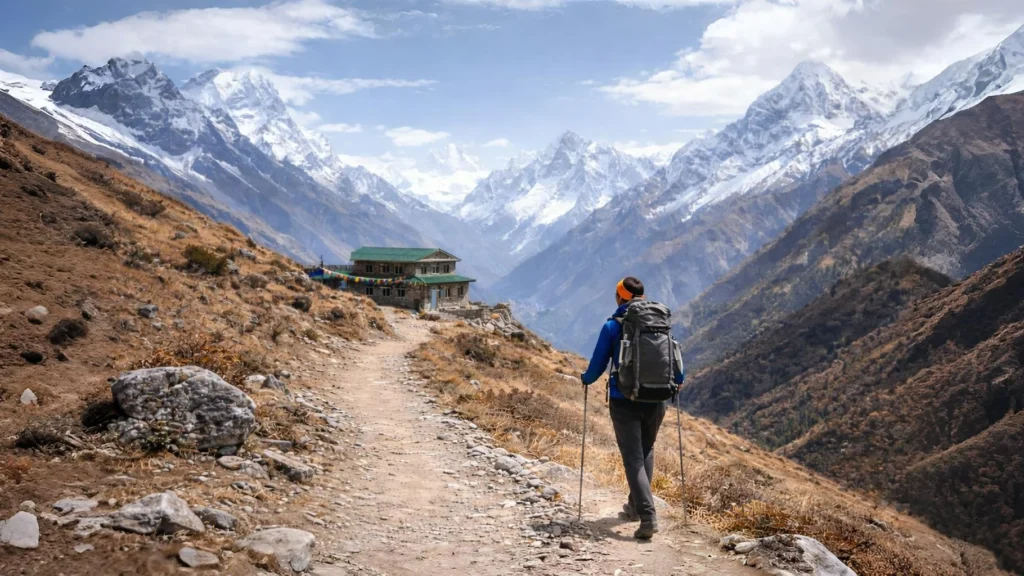
This is not a blanket endorsement of trekking without a guide. It is a conditional acknowledgment that, within clearly defined corridors, independent trekking can function safely and predictably. The Himalayas are not uniformly hostile, but only certain routes offer enough infrastructure, traffic, and escape options to absorb mistakes without turning them into emergencies.
The Trail Moment
You’re walking a clear path through forest and villages. Chai stalls appear every few hours. Other trekkers pass regularly. You’re sleeping in homestays, carrying little more than a daypack. If weather turns or someone feels unwell, a roof and hot food are never more than a short walk away. Here, the question of a guide is not about survival, it’s about convenience.
Why This Works: The Safety-Net Effect
Independent trekking becomes reasonable when multiple safety buffers exist at the same time:
- Human presence: Villagers, lodge owners, and other trekkers mean help is usually nearby for minor injuries or navigation errors.
- Infrastructure: Teahouses and homestays remove the need for heavy loads, fuel planning, and campsite judgment.
- Easy retreat: Regular road access or known descent routes allow fast exits if altitude, weather, or health deteriorates.
When all three overlap, mistakes tend to result in inconvenience-not catastrophe.
Where Independence Is Commonly Viable
These routes share one defining feature: continuous human movement.
- Markha Valley (Ladakh): A village-linked trail with lodging every few hours, clear navigation, and manageable altitude. Acclimatization still matters, but logistical risk is low.
- Sandakphu–Phalut (West Bengal/Sikkim): A well-defined ridge walk with lodges throughout. Permits are required, but guides are not legally mandatory for this route.
- Valley of Flowers (Uttarakhand, peak season): A highly managed corridor with constant foot traffic and forest department oversight. Independence here means flexible pacing, not isolation.
These are not wilderness routes, they are structured trekking environments.
What Can Still Go Wrong
The main risk in these zones is complacency, not exposure.
- Rushed acclimatization: Easy access can tempt trekkers to gain altitude too quickly.
- Peak-season pressure: Lodges fill up; lack of bookings can mean long, exhausting days.
- Seasonal misjudgment: A benign trail can become muddy, icy, or snow-covered outside its ideal window.
The safety net reduces consequences, it does not eliminate them.
⚠️Key Takeaway: Independent trekking works best where the environment cushions mistakes. If an error leads to discomfort or delay rather than danger, independence is usually reasonable.
The “Green Zone” Checklist
A route is a candidate for independent trekking only if it satisfies most of the following:
- Altitude ceiling: Mostly below ~4,000 m, or higher only with easy descent options
- Settlement frequency: Villages or lodges every 5–6 walking hours
- Clear navigation: Well-trodden, unambiguous trails
- Legal access: No mandatory guide or escort requirements
- Communication: At least intermittent mobile coverage
- Exit routes: Multiple, known bail-out options to roads or lower valleys
If several of these are missing, you are leaving the “reasonable independence” zone, and entering terrain where a guide materially reduces risk.
Important note: “Usually reasonable” does not mean risk-free. You remain responsible for fitness, acclimatization, weather awareness, and basic first aid. Independence shifts responsibility, it does not remove it.
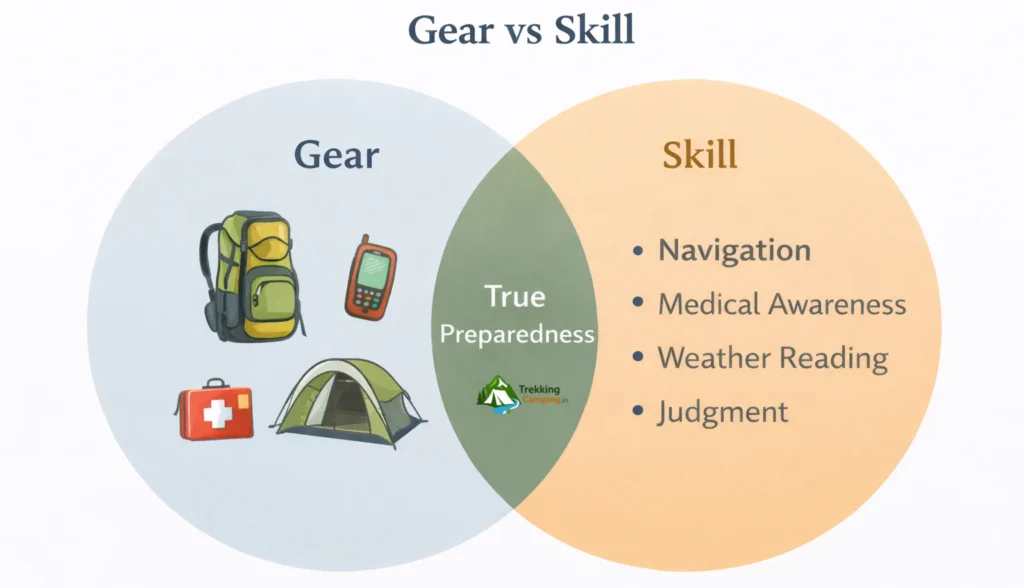
The Decision Tree – Should You Hire a Guide?
This section converts everything discussed so far into an operational decision framework.
It is not about personality, budget, or bravado. It is a logic test designed to bypass optimism and expose risk.
Answer each question with strict honesty.
A “No” at any safety-critical step is not a failure-it is data.
How to Use This Decision Tree
- Start at the top.
- Answer Yes or No only. No “probably” or “I think so.”
- Follow the path your answer dictates.
- The endpoint is a recommendation, not an order, but it is an informed one.
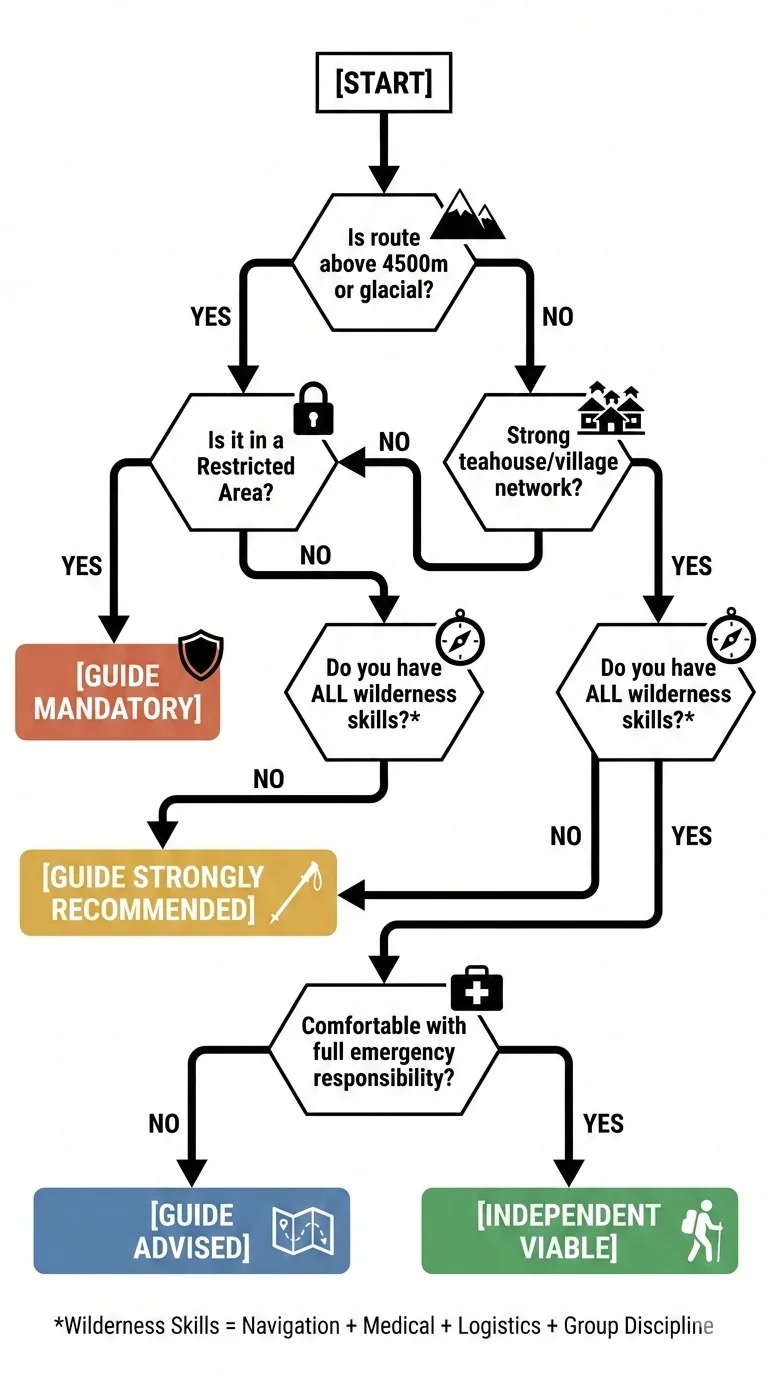
Follow each branch honestly. A single “No” at any safety-critical point shifts the recommendation toward hiring a guide.
Interpreting Your Outcome
- Guide is mandatory:
The decision is made. Focus on vetting credentials and local experience. - Guide strongly recommended:
Proceeding solo means knowingly accepting identified risks. A guide materially reduces them. - Independent trekking is viable:
No major red flags in law, terrain, or skills. Proceed independently-but rigorously.
Download the Himalayan Guide Decision Tree (PDF)
The Unspoken Branch (Most People Miss This)
If this tree points you toward a guide for your dream trek, your options are not limited to:
- Hire a guide
- Ignore the risk
There is a third, often wiser option:
Choose a different trek, one that naturally leads to the “Independent trekking is viable” outcome.
Changing the route is not compromise.
It is strategic alignment.
The Hidden Variable – Group Dynamics
So far, this article has treated “the trekker” as a rational, unified decision-maker.
In reality, you are almost never just an individual on the trail.
You are:
- Alone
- Part of a peer group
- Or inside a guided team
This social layer is not peripheral. It is a primary risk multiplier.
In many incidents, group dynamics-not terrain or weather-are the factor that turns manageable risk into an accident.
The Trail Moment
Your group of four reaches a high pass at noon.
The weather is holding, but clouds are building.
Two people feel strong and want to push on to the scenic lake below.
One is fatigued and unusually quiet.
Another is uneasy about the clouds, but doesn’t want to “kill the vibe.”
There’s no guide to arbitrate.
No one wants to be the pessimist.
No one wants to slow the group.
A silent negotiation begins.
This is where accidents are incubated.
Why This Happens: The Mechanics of Social Risk
Without a designated, trained leader, groups are vulnerable to predictable psychological failures:
- Diffusion of Responsibility
“Someone else checked the weather.”
“I assumed you brought the filter.”
Critical tasks fall through invisible cracks. - Expert Halo & Social Proof
The most confident person becomes the leader, regardless of actual competence.
Others suppress doubts and follow. - Commitment & Consistency Bias
“We’ve come this far.”
Emotional investment overrides new risk information. - Conflict Avoidance
Raising concerns feels socially costly.
Silence feels easier than being labeled “negative.”
Consequences: How Capable Groups Make Bad Decisions
These dynamics don’t just cause tension, they produce concrete hazards:
- Pace Mismatch
Groups unconsciously move at the pace of the strongest member, forcing others into exhaustion or altitude illness. - Suppressed Symptoms
Headaches, nausea, or dizziness are hidden to avoid “slowing everyone down.” - Collective Blindness
The group reinforces a single optimistic interpretation of conditions while dismissing contradictory signals.
⚠️Key Takeaway:
Your group’s interpersonal chemistry is part of your safety system.
Ignoring it is like ignoring the condition of your tent.
A guide’s hidden value is not navigation, it is professional authority.
They exist to override dangerous social dynamics when safety is at stake.
Group Style Analysis: Risk & Mitigation
| Group Style | Inherent Risks | Key Mitigation Strategy (If Independent) |
| Solo Trekker | Total isolation. No symptom monitoring. No companion rescue. Decision fatigue. | Choose only high-traffic teahouse routes. Maintain strict daily check-ins with a home contact. Carry a local SIM with known coverage. Be aggressively conservative. |
| Peer Group (Friends / Couple) | “Democracy trap.” Unclear leadership. Skill mismatch. Friendship suppresses honest safety talk. | Create a Pre-Trip Charter. Appoint a rotating Safety Officer. Establish non-negotiable turn-back rules. Normalize “time-out” calls with zero justification required. |
| Ad-Hoc Group (Met Online) | Unknown skills and risk tolerance. Low trust in crisis. Conflicting objectives. | Require a shakedown hike together. Share experience logs. Agree explicitly on the primary objective (summit vs experience vs photography). |
| Guided Commercial Group | Reduced autonomy. Fixed itinerary. Group fitness mismatch. Guide quality dependency. | Vet operators rigorously. Ask about max group size (<12 ideal), guide-to-client ratio, and pace-management protocols. Prefer small-group or custom itineraries. |
The “Pre-Mortem” Exercise (Highly Recommended)
Before an independent trek, conduct this 20-minute exercise:
Step 1: Imagine Failure
“One week after the trek, it went badly wrong. Someone was seriously hurt. What happened?”
Step 2: Identify Social Causes
Focus on decision failures, not just weather.
- “We didn’t want to tell Raj he was struggling.”
- “We ignored clouds because the camp booking was expensive.”
- “No one knew how to navigate once the phone died.”
Step 3: Install Safeguards
Convert each failure into a rule.
- Cause: Pushing pace
Safeguard: Daily pulse/SpO₂ checks. Anyone can call for a slower pace-no debate. - Cause: Ignoring weather
Safeguard: Pre-defined turn-back time or condition for passes. - Cause: Navigation failure
Safeguard: At least two members must be competent with map and compass; practice beforehand.
This exercise exposes hidden risk before fatigue and emotion take over on the trail.
The Bottom Line
If your group cannot comfortably discuss fear, fitness limits, and failure before the trek, you are not ready to operate independently in a high-stakes environment.
In such cases, a guide is not a luxury or convenience.
They are the missing control system in your group’s risk management.
If You Do Hire a Guide – How to Choose Well
If the decision tree points you toward hiring a guide, that outcome is not a compromise, it’s competent risk management.
But the decision does not end there.
A poor guide is more dangerous than no guide at all.
They create an illusion of safety without the competence to sustain it.
At this stage, your role shifts from route planner to professional vetter. You are no longer buying a service, you are appointing a field manager for a high-consequence environment.
The Trail Moment
You are halfway across a high, exposed pass.
The forecasted “weather window” collapses. Snow begins to fall sideways.
Your guide-cheerful and confident until now-falls silent.
He checks the sky.
Then his phone. No signal.
Then the map, with the same uncertainty you feel.
The danger is no longer the storm.
It is the realization that the person responsible for navigating it may not be qualified to do so.
Why This Happens: The “Local ≠ Expert” Fallacy
Many trekkers assume that anyone from a mountain region is a competent guide. This assumption is false, and hazardous.
- Local knowledge is not systematic training
Knowing a trail does not equal understanding weather systems, altitude pathology, or rescue decision-making. - The Porter–Guide Confusion
A porter is a logistical asset.
A guide is a safety officer trained to make judgment calls under pressure.
Confusing the two roles is a critical planning error. - The Invisible Title Problem
In the informal trekking economy, “guide” is an unregulated label.
The burden of verification rests entirely on you.
Consequences of Hiring the Wrong Guide
An incompetent guide creates compounded risk:
- Complacency
You disengage your own judgment, assuming safety is being handled. - Misplaced Trust
You follow decisions you would question if you were trekking independently. - Failure Under Stress
In a real emergency, an untrained guide may freeze, panic, or escalate the situation, while you have already surrendered control.
⚠️Key Takeaway:
Hiring a guide is a due-diligence exercise.
You are not booking a taxi.
You are hiring someone to make irreversible decisions in a volatile environment.
Apply the same rigor you would use when hiring a professional for any safety-critical role.
Certifications That Actually Matter (And What They Mean)
Ignore vague claims of “experience.” Look for verifiable training.
| Certification / Affiliation | What It Actually Signifies | What to Ask or Verify |
| Indian Mountaineering Foundation (IMF) – BMC / AMC | India’s most rigorous formal training in mountaineering, navigation, rescue, and expedition leadership. | Ask for certificate number and year. Ask: “What was the most difficult skill you learned during your course?” |
| ATOAI Membership | Adherence to professional safety standards, ethics, insurance, and trained staffing. | Verify current membership. Ask: “What is your emergency protocol for high-altitude illness?” |
| Wilderness First Responder (WFR) / Wilderness First Aid (WFA) | Medical decision-making in remote environments, far more relevant than generic first aid. | Ask: “How do you differentiate and manage HAPE vs HACE in the field?” |
| State Tourism Licensed Guide | Legal permission to operate. Rigor varies widely. | Treat as a baseline requirement, not proof of competence. |
✅ The Portfolio Test: Ask for photos or logs from previous treks on the same route and season.
Pay attention to gear condition, river crossings, snow management, and team preparedness—not scenery.
Questions Worth Asking (This Is an Interview)
Move beyond dates and pricing. Their answers reveal their risk philosophy.
1. Safety & Decision-Making
- “What are your non-negotiable turn-back conditions?”
(Look for specific triggers: weather, health, time.) - “How do you monitor altitude adaptation?”
(Strong answer: daily SpO₂ checks, appetite/gait observation, planned acclimatization.) - “What is your evacuation plan on this route?”
(They should know landing zones, contacts, and timelines.)
2. Logistics & Ethics
- “What is your guide-to-trekker ratio?”
(High altitude: ideally ≤1:6, with assistant guides for larger groups.) - “How do you manage waste and environmental impact?”
(Look for specifics, not slogans.) - “How are porters and support staff equipped and compensated?”
(Ethical operators have clear load limits, gear standards, and wages.)
3. The “What-Ifs”
- “How do you manage mixed fitness levels?”
- “Can I see your mandatory client gear list?”
- “What costs are not included that I should budget for?”
Red Flags 🚩
- Vagueness: “Don’t worry, we handle everything.”
- Dismissiveness: Avoiding detailed safety questions.
- Pressure Tactics: “Book now-last slot!”
- No Written Agreement: No clarity on insurance, cancellations, or liability.
- No References: Refusal to connect you with past clients.
⚠️Final filter:
Ask yourself:
“Would I trust this person to make a life-or-death decision for me in a whiteout at 5,000 meters?”
If the answer isn’t an immediate yes, keep looking.
Can’t or Don’t Want a Guide? Safer Alternatives
If the decision tree points toward hiring a guide, but budget, timing, or a desire for solitude makes that impractical, your options are not binary.
You do not need to abandon trekking altogether.
You do need to downgrade ambition and compensate with discipline.
This section is about building the safest possible independent plan when a guide is not an option—not about recreating guided safety, which is impossible.
The Trail Moment
You’ve researched a high-altitude dream trek. The cost of a certified guide puts it out of reach.
Instead of forcing the plan-or canceling the season-you return to the map. You choose a lower route that links villages, avoids glaciated terrain, and offers frequent exits. There is no famous pass or summit photo.
What you gain instead is continuity, culture, and a margin for error.
This is not settling.
It is choosing a trek that matches reality.
Core Principle: Route Choice Is Risk Management
Not every meaningful Himalayan journey involves extreme altitude or isolation.
Village corridors, cultural routes, and mid-altitude valleys often offer more interaction, more flexibility, and far lower consequence when things go wrong.
The trade-off is simple:
- You give up ego-driven objectives
- You gain a high probability of finishing safely
Strategic Alternatives (With Clear Limits)
1. The Experienced Companion (Not “Just a Friend”)
What it is:
Trekking with someone who possesses skills you explicitly lack (navigation, wilderness medicine, logistics) and whose judgment you trust under stress.
Protocol:
- Define roles before departure (e.g., Medical Lead, Navigator)
- Practice together (map/compass, first aid scenarios)
- Treat the trek as a joint responsibility, not a casual holiday
If roles are unclear, this is not an alternative-it’s a liability.
2. The Local Porter-Plus (With Boundaries)
What it is:
Hiring a local porter who knows the trail and terrain.
What it is not:
A substitute for a certified guide.
Rules:
- Explicitly limit their role (carrying load, showing known trail)
- All safety, medical, and weather decisions remain yours
- Ensure they are properly equipped, ethically and practically
Never outsource judgment to someone you did not hire for that purpose.
3. Conservative Route Selection (“Green Zone” Treks)
What it is:
Choosing routes that inherently support independent trekking.
Actively seek:
- Teahouse corridors (Markha Valley, Sandakphu)
- Low-altitude cultural trails (Kumaon & Garhwal mid-hills, Himachal village routes)
- Managed forest trails (e.g., Great Himalayan National Park, often with low-cost local guides)
If a route only becomes “safe” with skill heroics, it is not a Green Zone route.
4. Basecamp + Day-Hike Model
What it is:
Staying multiple nights in one village and doing exploratory day hikes.
Why it works:
- No heavy pack
- Risk limited to daylight hours
- Immediate access to shelter and help
Ideal bases:
Mcleodganj–Dharamkot, Old Manali, Yuksom, parts of Kumaon villages.
This model offers depth without expeditionary risk.
The No-Guide Final Checklist (Non-Negotiable)
Before committing to any independent alternative, confirm all of the following:
- Route intelligence:
Have you spoken to someone who walked this route in the same season within the last year? - Bail-out clarity:
Can you name at least two exit routes to roads or major villages from any point? - Medical plan:
Do you have written protocols for AMS, GI illness, injury, and a researched evacuation plan? - Communication reality:
Do you know where mobile signal exists? Do you have power backup and offline contacts? - Weather buffer:
Can you absorb 24–48 hours of delay without pressure to move? - Turn-back pact:
Are your turn-back conditions written, fixed, and shared with someone off-trail?
If any answer is “no,” this is not a safe alternative.
It is a risk you are choosing to ignore.
🏞️ Final Principle
Choosing to trek without a guide demands more humility, more preparation, and stricter limits than hiring one.
It is not the easy option.
It is simply a different form of responsibility.
Seasonal Reality Check: When the Calendar Decides for You
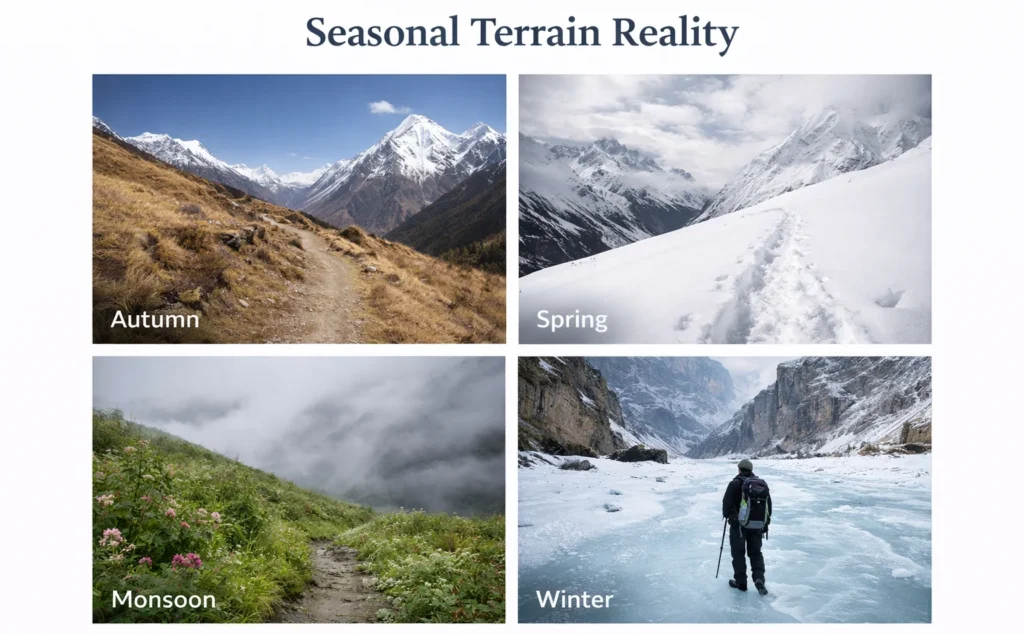
In the Himalayas, seasons are not scenery. They are operating systems.
A route that is a straightforward walk in October can become a snowbound mountaineering problem in May, or a slick, unstable hazard in August. The “guide vs independent” decision is often made before you step on the trail, simply by when you go.
Ignoring seasonality is like planning a sea crossing without checking tides. The map stays the same. The risk does not.
The Trail Moment
It’s early June. You’re following a GPX track from a blog titled “Perfect October Trek.”
Instead of a gentle contouring trail, you’re staring at a steep snow chute-half-melted, unstable, and invisible on your map. You have no ice axe, no traction, and no safe margin for a slip. The October photos didn’t lie, but they didn’t apply.
The season has rewritten the terrain. Your preparation hasn’t caught up.
Why This Happens: The Three Himalayan Operating Modes
The Himalayas don’t behave in four neat seasons. Practically, they operate in three distinct risk modes, each redefining what “independent” means.
1. The Thawing Giant (Late April–June)
- Persistent snow on passes and shaded slopes
- Snow bridges over streams that weaken daily
- Violent afternoon river crossings from meltwater
- Trails destabilized by freeze–thaw cycles
🚨 Core risk: Underestimating how much winter still exists on the ground. A trekking route quietly becomes a snow-travel problem.
2. The Monsoon Realm (July–Mid September)
- Daily rain, cloud build-up, and near-zero ridge visibility
- Trails erode into mud or disappear entirely
- Leeches, landslides, blocked roads, delayed exits
🚨 Core risk: Thinking “rain” is the problem, when the real danger is isolation, navigation failure, and compromised escape routes. reminders]
3. The Stable Window (Late September–November)
- Dry trails, lower rivers, stable weather
- Clear skies and predictable conditions
- The reference season for most trail descriptions
🚨 Core risk: Complacency. This is when independent trekking is most viable, and when people overextend onto routes that remain objectively serious.
Key Consequences of Getting the Season Wrong
Seasonal mismatch causes two predictable failures:
- Operational failure:
The trek becomes unsafe, miserable, or impossible. You turn back late, not early. - Silent skill inflation:
A “non-technical” trek suddenly demands snow travel, avalanche awareness, or river-crossing judgment you don’t have.
Your trek didn’t change.
Its required competence did.
Seasonal Decision Matrix (India-Specific)
| Season | Ground Reality | Impact on Guide Necessity | Safer Independent Focus |
| Spring (Apr–Jun) | Snow on passes >4000m, unstable snow bridges, violent PM river crossings | Very High – snow assessment & timing become critical | Low-altitude thawed valleys (<3500m), rhododendron trails, desert valleys (cold but dry) |
| Monsoon (Jul–Mid Sep) | Mud, landslides, washed-out trails, whiteouts | High – navigation & terrain judgment are professional skills | Rain-shadow regions (Ladakh, Spiti, Zanskar) with road-access buffers |
| Autumn (Late Sep–Nov) | Stable, dry, predictable | Lowest – decision tree applies most cleanly | Teahouse treks, high-traffic routes, classic independent corridors |
| Winter (Dec–Mar) | Deep snow, extreme cold, closed routes | Absolute – winter trekking is specialized | Guided-only; consider foothill village walks instead |
The Seasonal Gate: Questions You Must Answer
Before finalizing any independent plan, ask:
- For your exact dates, where is the historical snow line?
- Will high points be snow-free, icy, or consolidated snow?
- What is the daily precipitation pattern at altitude?
- Are river crossings time-sensitive (morning vs afternoon)?
- Are villages, teahouses, and camps actually open?
Where to get real answers:
- Trip reports from the last 2–3 weeks, not evergreen blogs
- Local guides or operators (even if you don’t hire them)
- Forest department or tourism office updates
- Satellite imagery + recent photos from trekkers
Key Takeaway
Before asking “Can I do this trek without a guide?”
You must first ask:
“What does this trek become in this month?”
A guide’s value often lies in interpreting the season.
If you go independent, that responsibility shifts entirely to you.
Matching your ambition to the mountain’s current mood, not its reputation, is the first and most important safety decision you’ll make.
Judgment Is the Real Skill in the Himalayas
We began with a simple, urgent question: Do I need a guide?
Along the way, we examined legal requirements, seasonal filters, medical realities, group dynamics, and decision trees. But these are only instruments. They exist to cultivate the single capability that matters most in the Himalayas: judgment.
The mountains do not reward courage, fitness, or experience in isolation. They reward alignment, between your decisions and an environment that is indifferent to your intentions. Judgment is the ability to recognize that alignment in real time. It is the quiet override that tells you to descend when the weather shifts, to stop when a headache is no longer “just a headache,” or to choose a lesser route when the greater one exceeds your honest capacity.
A successful trek is not defined by reaching a marked point on a map. It is defined by returning with a clearer understanding of where capability ends and consequence begins.
The Guide as a Judgment Amplifier
This reframes the purpose of hiring a guide.
You are not purchasing convenience, nor admitting weakness. You are integrating an external judgment system into your trek. A competent guide brings hyper-local terrain knowledge, trained observation of physiological change, and – most importantly – objectivity. They exist to counter the cognitive biases that altitude and fatigue amplify: optimism, commitment, ego, and sunk-cost thinking.
A guide does not walk for you.
They think with you – and, when necessary, for you – when your own clarity erodes.
The Independent Trekker’s Higher Burden
For the independent trekker, the challenge is doubled.
You are not only executing the trek; you are also acting as your own guide. You are the navigator, safety officer, medic, and risk assessor. This is possible—but it is a higher-order skill. It demands a level of pre-trip honesty that often feels uncomfortable. It requires interrogating your motives:
Are you choosing independence for the right reasons, self-reliance, solitude, competence?
Or for the wrong ones, budget pressure, pride, or an incomplete understanding of risk?
Independence without judgment is not freedom. It is exposure.
The Real Decision Was Never “Guide vs No Guide”
The real decision is this:
How will sound judgment be preserved on this trek?
- Will it come from internal discipline, built through conservative planning, practiced skills, and group protocols that survive stress?
- Or will it be externally scaffolded by a professional whose training and detachment form a guardrail against inevitable human error?
There is no universally correct answer. There is only a correct answer for you, on this route, in this season, with your actual, not aspirational, skills.
The decision tree is not a test to pass or fail. It is a mirror. Its purpose is to expose the gap between how a trek is imagined and how it actually functions on the ground.
The Unspoken Trekking Ethic
As Himalayan trekking grows, judgment becomes more than a personal concern, it becomes an ethic.
Poorly judged decisions rarely affect only the trekker. They draw on limited rescue resources, endanger responders, and reinforce the idea of the mountains as a hostile playground rather than a living system that demands respect. Well-judged treks, guided or independent, minimize impact, respect local protocols, and leave fewer scars on both people and place.
The future of Himalayan trekking belongs not to the boldest, but to the most judicious.
It belongs to those who can stand before a vast, indifferent landscape and answer one question honestly:
Do my skills, preparation, and judgment belong here today?
The mountains will remain. Their test is not whether you can reach the top, but whether you know when to turn back, when to ask for help, or when to choose a different path altogether.
That wisdom, earned through humility, preparation, and respect for consequence, is the only piece of gear you cannot buy.
FAQs: Do You Need a Guide in the Himalayas?
Is trekking without a guide always more dangerous?
No. On low-altitude, high-traffic routes with established infrastructure (such as Sandakphu), independent trekking can be safe. Risk increases sharply with altitude, isolation, and technical terrain.
How can I verify if a guide is legitimate?
Ask for their Indian Mountaineering Foundation (IMF) certification number and verify it. For operators, check membership with ATOAI or state tourism boards. Reputable guides provide this willingly.
Can I decide to hire a guide mid-trek?
Rarely, and at high cost. Availability is uncertain, and logistics become complex. This decision must be made before you start, using a framework like the one in this article.
Do you need a guide in the Himalayas?
Yes and No. It depends on several key factors. Check the decision tree image for a quick answer. You can download the PDF and save it to use later.
Is going solo always more dangerous in the Himalayas?
No. Independent trekking in the Himalayas is not always more dangerous – but the risk increases sharply with altitude, isolation, and technical terrain.
Trekking without a guide can be reasonably safe on low-altitude, high-traffic routes with established infrastructure, such as teahouse treks where villages, shelters, and other trekkers are encountered regularly. In these environments, mistakes usually lead to inconvenience rather than catastrophe.
However, solo or independent trekking becomes significantly more dangerous when:
1) The route exceeds 4,500 meters
2) There are no villages or teahouses for long stretches
3) Navigation is complex or weather-dependent
4) Emergency response would be delayed by many hours or days
In the Himalayas, danger is not defined by whether you trek alone — it is defined by how forgiving the environment is when something goes wrong.
When is a guide mandatory in the Himalayas?
A guide is legally mandatory for trekking in many parts of the Indian Himalayas, regardless of your experience.
You must hire a guide when:
1) Trekking in Restricted or Protected Areas, such as:
a) North & East Sikkim (e.g., Goechala, Green Lake)
b) Border regions of Ladakh
c) Certain zones in Uttarakhand biosphere reserves
2) Permits are issued only through registered operators, which include guide services by default
3) Trekking in winter conditions on routes like the Chadar Trek
Even where not strictly required by law, guides are often effectively mandatory on:
i) Glacial routes
ii) High-pass crossings above 5,000m
iii) Long, isolated treks with no villages
Before planning independent trekking in the Himalayas, always verify the current permit rules for your route, enforcement changes frequently.
How do I verify a trekking guide’s certification in India?
To verify a trekking guide’s credentials in India, look for formal training and traceable affiliations, not just local familiarity.
Key certifications and checks:
1) Indian Mountaineering Foundation (IMF)
Ask for the guide’s BMC or AMC certificate number and year. These are the most respected mountaineering qualifications in India.
2) Adventure Tour Operators Association of India (ATOAI)
Verify whether the operator is a current member. ATOAI members must meet safety, insurance, and guide-training standards.
3) Wilderness First Aid (WFA) or Wilderness First Responder (WFR)
Essential for managing altitude sickness and remote injuries during trekking in the Himalayas.
A qualified guide will answer verification questions clearly and without hesitation. Vagueness, dismissal, or pressure to book quickly are red flags.
What is the safest Himalayan trek without a guide?
The safest options for trekking without a guide in the Himalayas are low-altitude routes with continuous infrastructure and high foot traffic.
Well-known examples include:
1) Markha Valley (Ladakh) – village-to-village teahouse trekking with clear trails and regular settlements
2) Sandakphu–Phalut (West Bengal/Sikkim) – ridge walk with lodges and minimal navigation risk
3) Valley of Flowers (Uttarakhand, peak season) – heavily managed trail with forest department presence
These routes are suitable for independent trekking because:
A) Altitude remains moderate
B) Help is never far away
C) Navigation errors are unlikely to become life-threatening
No Himalayan trek is “risk-free,” but these corridors offer the widest margin for error when trekking without a guide.
We review and update our guides periodically based on new field insights, safety advisories, and reader feedback.